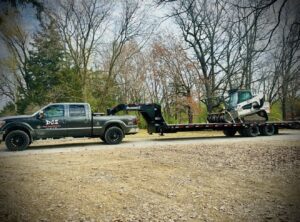
It’s one of the first questions Minnesota property owners ask when they decide it’s finally time to clear that overgrown back lot, open up a lakeshore view, or carve out a food plot in the woods behind the house: What’s this going to cost me? And it’s a fair question — because forestry mulching isn’t something with a price tag at the hardware store. Most people have never hired this kind of work before.
The honest answer is: it depends. But that doesn’t mean you should go in blind. Here’s a realistic breakdown of forestry mulching costs in Minnesota — what you’ll actually pay, what drives the price up or down on MN terrain, and how to make sure you’re getting a fair quote and not just the cheapest one.
Typical Forestry Mulching Prices in Minnesota
Minnesota contractors generally price forestry mulching one of two ways: by the hour or by the acre. Both are common, and which one you’ll see depends on the contractor and the nature of the job.
Hourly Rates
Expect to see hourly rates in the range of $150–$400 per hour for a single machine and operator. The wide range reflects differences in machine size, head type, and what’s being cleared. A compact skid steer with a mulching head on light brush moves fast and bills at the lower end. A full-size tracked forestry machine chewing through dense stands of 6-inch oak and buckthorn is going to bill at the top of that range — and work more slowly by the hour, but tackle material a smaller machine can’t touch.
Per-Acre Rates
For larger jobs, many contractors — including DCS Brush Control — will price by the acre. Realistic per-acre pricing in the Minnesota market runs $800–$2,500 per acre, with the wide spread driven almost entirely by vegetation density and site conditions. Light brush and small-diameter trees on open ground with good equipment access? You’re closer to $800–$1,200/acre. Dense birch, aspen, or overgrown buckthorn thickets with downed timber mixed in, on a wet or sloped site? That number climbs fast.
What Drives Forestry Mulching Costs Up in Minnesota
Not all acres are equal. Here are the specific factors that push your price higher on a Minnesota property:
Dense Brush and Large-Diameter Timber
The thicker and bigger the material, the slower the machine works and the more wear it puts on cutting teeth. A stand of mature aspen or red oak takes significantly more time per acre than light scrub. Downed timber — common after storm damage or years of neglect — creates extra work because the machine has to process both standing and ground-level material.
Steep Slopes and Rough Terrain
The glacially-shaped terrain of Scott County and the broader lake region means plenty of rolling hills, creek banks, and uneven ground. Slopes slow equipment movement and increase safety margins, which means more time on the clock. Heavily wooded hillsides above lakeshore lots — common around Prior Lake, Spring Lake, and area lakes — are some of the more time-intensive work in this region.
Wet Ground and Spring Mud Season
This is a uniquely Minnesota problem. Our spring mud season — roughly mid-March through May, depending on how fast the frost comes out — turns many rural properties into a soft mess. Contractors may decline work on wet sites to avoid deep rutting, or they’ll charge a premium for the added difficulty and risk. If your property has low areas, seasonal wet spots, or clay soils that stay saturated, expect either a higher quote or a scheduling conversation about timing.
Lakeshore and Buffer Zone Work
Clearing near water requires careful equipment placement, sometimes hand-work near the shoreline edge, and awareness of DNR shoreland buffer rules. That level of precision takes more time than open-field work, and responsible contractors price it accordingly.
Limited Equipment Access
If your property doesn’t have a wide gate, a solid road in, or flat ground to unload from, expect a higher quote. Moving equipment through a narrow residential lot in Shakopee or accessing a back parcel in Elko New Market via a soft two-track adds time to the job before the mulching even starts.
What Brings Forestry Mulching Costs Down
The flip side: several factors work in your favor and can keep costs at the lower end of the range.
- Light, uniform brush density — younger growth, consistent diameter, no large downed timber
- Flat, open terrain with firm ground — the machine moves fast and efficiently
- Good access — a wide gate, solid driveway, or easy field access cuts setup time significantly
- Dry conditions — late summer and fall work, after a dry stretch, is ideal for Minnesota sites with clay soils
- Larger acreage — most contractors offer better per-acre pricing on larger jobs because setup and mobilization costs are spread across more acres
Seasonal Pricing and Minnesota Timing
Timing matters more in Minnesota than in most states. Spring is in high demand, but spring is also when ground conditions are most problematic — the freeze-thaw cycle leaves soils saturated and soft, and many contractors will push back on spring bookings on wet sites. Summer is ideal for most properties: ground is firm, access is reliable, and the dry spells allow efficient work. Fall is excellent for food plot and hunting property projects — clearing in September or October gives the mulch a full winter to start breaking down before you seed in spring. Winter clearing on frozen ground is an option some contractors offer and can actually be ideal for wet or low-lying properties where frozen ground is the only way to get equipment in without damage.
Why the Cheapest Quote Isn’t Always the Best Deal
This matters. A low bid might mean a smaller machine that takes twice as long and leaves a rougher result. It might mean a contractor cutting corners on equipment maintenance, resulting in poor mulch quality — large chunks instead of fine material that breaks down well. It can also mean someone who isn’t familiar with Minnesota DNR shoreland rules and will clear right up to the water’s edge in a way that leaves you exposed to regulatory problems. Ask about the machine being used, how the contractor handles lakeshore buffer compliance, and whether they do a site walk before giving you a number.
Questions to Ask Before Hiring a Minnesota Forestry Mulching Contractor
- Will you walk the site before giving a quote?
- What machine and head are you using — and is it the right size for my job?
- How do you handle wet ground or spring conditions on clay soils?
- Do you have experience working near shoreland buffer zones?
- Is the quote all-in, or are there add-ons for access, mobilization, or difficulty?
- Are you insured and licensed to work in Minnesota?
How DCS Brush Control Prices Jobs
At DCS Brush Control, we start with a free on-site estimate — no phone guessing games. Jake walks the property, looks at vegetation density, terrain, access, and proximity to water, and gives you a straightforward quote based on what’s actually there. Because we’re based right in Prior Lake, we don’t tack on long travel fees for jobs across Scott County and the south metro. Shakopee, Savage, Burnsville, Chaska, Jordan, Lakeville, Apple Valley — you’re not paying for us to drive two hours to get there.
We also know when not to schedule a job — if your ground is saturated and we’d do more harm than good, we’ll tell you that and pick a better window. That kind of honesty is what keeps customers calling us back for their next parcel or referring their neighbors.
Ready to get a real number for your property? Call DCS Brush Control at (612) 554-0795 or reach out through dcsbrushcontrol.com. We serve the Prior Lake area and the entire Twin Cities south and southwest metro — and we’ll give you a straight answer on what your project will actually cost.