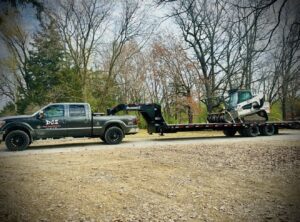
If you own acreage in Scott County, a lakeshore lot near Prior Lake, or a rural parcel out toward Jordan or Belle Plaine, you’ve probably stared at a wall of overgrown birch, buckthorn, and scrub brush and thought: I need to do something about this. But when you start calling contractors, you’ll hear two very different approaches — forestry mulching and traditional land clearing. They’re not the same thing, and choosing the wrong method for a Minnesota property can cost you more money, damage your soil, and even put you on the wrong side of DNR shoreland rules.
Here’s a straight-talk breakdown of forestry mulching vs. land clearing in Minnesota — what each one actually is, when to use which, and what matters most on our specific terrain.
What Is Forestry Mulching?
Forestry mulching is a single-machine process. A tracked or wheeled machine — most commonly a skid steer or dedicated forestry mulcher like a Fecon or Denis Cimaf head on a high-flow carrier — grinds trees, brush, and stumps directly into a layer of wood chip mulch right on the ground. No hauling. No burning. No second pass to clean up debris.
The machine chews through material up to 6–8 inches in diameter (sometimes larger depending on the head) and leaves behind a blanket of shredded organic material 2–4 inches thick. That mulch layer does something useful: it suppresses weeds, holds moisture, and breaks down over time into the soil. On Minnesota’s heavy clay soils — common across Scott, Dakota, and Carver counties — that organic matter is genuinely valuable.
The ground disturbance is minimal. The machine’s tracks spread weight across a wide footprint, and because there’s no dozer pushing soil around, the topsoil profile stays largely intact. You finish the job with cleared land that’s ready for seeding, food plots, landscaping, or simply open views to the water.
What Is Traditional Land Clearing?
Traditional land clearing typically involves a dozer, excavator, or skid steer pushing and piling trees and brush, followed by hauling the debris off-site or burning it in place. It’s the older method — effective for breaking ground on large construction sites — but it comes with real downsides for most residential and rural Minnesota properties.
First, burning. Open burning in Minnesota is heavily regulated. Many metro-adjacent counties — including Scott County — have seasonal burn bans, and lakeshore properties are often entirely off-limits for open burning near the shoreline buffer zone. Getting the permits, timing the burn to weather conditions, and managing the fire risk is a headache most landowners don’t want.
Second, hauling. If you’re paying to truck debris to a landfill or chipping facility, that’s a significant added cost on top of the clearing labor. A few acres of dense MN brushland can generate a surprising volume of material.
Third — and this is the issue that matters most in Minnesota — dozer work compacts soil. Hard. Our heavy clay soils, particularly in the glacially-deposited lowlands around the Minnesota River Valley and the lake country of Scott County, are already prone to compaction and poor drainage. Running heavy equipment across them, especially in spring when the ground is soft, creates ruts and a compacted hardpan that’s difficult and expensive to correct.
Forestry Mulching vs. Traditional Land Clearing: Side-by-Side
| Factor | Forestry Mulching | Traditional Clearing |
|---|---|---|
| Debris removal | Mulched in place — no hauling | Hauled off or burned — added cost |
| Soil disturbance | Minimal — topsoil stays intact | High — dozer work compacts and mixes soil |
| Speed | Fast — one machine, one pass | Can be fast on large open areas; slower cleanup |
| Cost | Typically lower all-in (no haul fees) | Higher when debris hauling is factored in |
| DNR/shoreland compliance | Easier — no burn, less erosion risk | Burn restrictions, erosion concerns near water |
| End result | Clean, mulched ground — ready to use | Bare ground — may need erosion control seeding |
When to Choose Forestry Mulching
For the vast majority of Minnesota landowners — lakeshore lot owners, hobby farmers, hunters building food plots, suburban homeowners clearing tree lines — forestry mulching is the right call. Here’s why:
Lakeshore and Shoreland Properties
Minnesota’s DNR Shoreland Management rules require vegetative buffers near most lakes and rivers. Forestry mulching allows you to selectively clear brush and invasive species while leaving root systems intact to prevent erosion — critical on lakeshore lots where bare soil can wash directly into the water after spring snowmelt. A dozer clearing that same strip can leave you with an erosion problem and a DNR complaint.
Clay Soil and Freeze-Thaw Terrain
Scott County’s soils are heavily clay-influenced, which means they’re vulnerable to compaction year-round and especially bad in spring when freeze-thaw cycles have saturated the ground. Forestry mulching equipment is far lighter on the land than dozer work. The mulch layer left behind also helps buffer the surface against freeze-thaw erosion over winter — a real benefit if you’re clearing in the fall.
Food Plots and Hunting Land
Hunters across the south metro and lake country use forestry mulching to open up food plots in dense oak and aspen stands. The mulch breaks down into nutrient-rich soil amendment — far better for establishing clover and brassicas than compacted bare ground left by a dozer.
When Traditional Clearing Makes More Sense
Traditional clearing isn’t always wrong — it’s just situationally appropriate. If you’re grading for a new building pad, installing a septic system, or dealing with large boulders and stumps that need to be physically removed, a dozer or excavator may be necessary. Forestry mulchers handle woody material well but aren’t designed to move large granite boulders left by the last glaciation (and there are plenty of those in Scott County). For full-site development clearing where the topsoil is being graded anyway, traditional methods may make more sense economically.
The Minnesota Bottom Line
For most property owners in the Prior Lake area and surrounding communities — Shakopee, Chaska, Jordan, Chanhassen, Elko New Market, Northfield — forestry mulching is the smarter, cleaner, and usually less expensive approach. It works with Minnesota’s terrain and climate rather than fighting it. You’re not fighting burn bans, not paying haul fees, and not left with compacted clay that grows nothing for three years.
Not sure which method your property needs? DCS Brush Control is based right here in Prior Lake, MN and serves the entire south and southwest metro. Jake Draeger and his crew know Scott County terrain — the clay, the lakeshore rules, the birch stands, the food plot setups. Give us a call at (612) 554-0795 for a free on-site estimate. We’ll tell you exactly what your property needs and why.