Buying raw land and building your own home is one of the most rewarding things a person can do — and one of the most logistically complicated. If you’ve recently purchased a wooded or brushy lot in Scott County‘s growth corridor — Shakopee, Savage, Jordan, Elko New Market, Credit River, or the Prior Lake area — you’re probably starting to realize that the land doesn’t clear itself.
Before a builder can pour footings, stage materials, or run utilities, the vegetation needs to go. And how you handle the clearing phase — the first phase of any new construction project — can meaningfully affect your build costs, your schedule, and the long-term performance of your lot.
This post covers what most new construction land buyers don’t know about land clearing services: what needs to happen before your builder arrives, how forestry mulching differs from full site grading, how to sequence the work, and what questions to ask before anyone drives a machine onto your property.
What Needs to Be Cleared Before Your Builder Shows Up
“Clear the lot” sounds simple, but there are actually several distinct phases involved — and they’re not always done by the same contractor. Understanding the difference before you hire anyone will save you time, money, and confusion.
Phase 1: Vegetation Clearing
This is what DCS Brush Control handles. We’ve been serving Prior Lake and the Twin Cities south metro for over four years. Vegetation clearing means removing all trees, brush, shrubs, saplings, and above-ground organic material from the building envelope and site access paths. This phase needs to happen before any grading, excavation, or utility work begins. Builders cannot efficiently work around standing vegetation, and grading contractors don’t want to find brush and stumps in their path.
Phase 2: Stump Processing
Stumps can be dealt with two ways: grind them down so the wood fiber stays on-site and decomposes over time, or pull them with an excavator and haul them away. Which approach you need depends on your site plan and your builder’s requirements. Within the actual building footprint — foundation, septic field, driveway — clean removal is typically required. In perimeter and yard areas, grinding and leaving the material in place is usually fine.
Phase 3: Grading and Excavation
Once vegetation and stumps are handled, your builder or grading contractor takes over. They’ll grade the site for drainage, establish the building pad, run utilities, and prepare for foundation work. This is a separate scope from clearing, done with different equipment by a different trade.
Getting these phases in the right order — and having the right contractor for each — is the biggest thing most raw land buyers overlook.
Forestry Mulching vs. Full Site Clearing: Which Do You Need?
This is the most common question we get from new construction buyers, and the answer depends on what your site plan and builder require.
When Forestry Mulching Is the Right Choice
A forestry mulcher uses a drum loaded with carbide teeth to cut, chip, and grind vegetation in a single pass. Everything that goes into the machine — brush, small trees, saplings, stumps under a certain size — comes out as mulch that stays on the ground. There’s no hauling, no burn piles, no off-site disposal cost.
This approach is well-suited for:
- Clearing access roads and driveways to the build site
- Removing woody vegetation and brush from areas outside the primary building footprint
- New construction lots where the site plan doesn’t require all organic material to be removed to mineral soil
- Areas being prepped for seeding, landscaping, or erosion control after the build
The mulch layer a drum mulcher leaves behind actually aids erosion control during construction — a meaningful benefit on sloped lots in the Twin Cities south metro, where Scott County’s heavy clay soil is vulnerable to runoff on disturbed ground. And because no material leaves the site, you’re not paying for trucking or disposal.
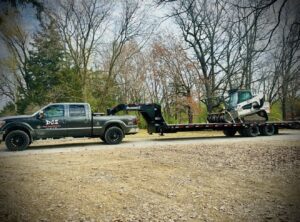
Our tracked carrier and drum mulcher handle trees up to 8–10 inches in diameter, which covers the large majority of vegetation on residential and rural building lots in the Prior Lake and Scott County area.
When You Need Grading and Excavation Instead
If your building footprint requires clean preparation to subgrade level — meaning no organic material, root systems, or decomposable matter in the soil below your foundation and driveway — then a grading contractor with an excavator handles that specific area.
Most new construction projects in Scott County use a practical combination: forestry mulching for the outer lot areas, buffer zones, and site access, with targeted excavation in the building pad area. DCS Brush Control handles the vegetation clearing phase and works with your builder to make sure the grading contractor arrives to a site that’s already prepped for their work.
Scott County’s Growth Corridor: What to Expect on Raw Land
The communities ringing Prior Lake — Shakopee, Savage, Jordan, Elko New Market, Credit River — have seen significant residential development in recent years. That means a lot of buyers are purchasing lots that haven’t been actively managed in decades, if ever.
What does that look like on the ground? On most wooded or transitional lots in Scott County:
Clay soil compaction is a real concern. Scott County’s clay-heavy soils drain poorly and compact easily under equipment, especially in spring. Sequencing your clearing work during drier fall conditions or on frozen ground can prevent soil damage that’s expensive to repair later.
Buckthorn and Eurasian honeysuckle are almost everywhere. These invasive species have colonized the understory of woodland areas throughout the Twin Cities south metro. Mechanical clearing cuts them down, but stump treatment is necessary to prevent aggressive regrowth that will compete with your landscaping for years.
Red oak (Quercus rubra) is the dominant native canopy species on many sites. Red oak is worth preserving where the site plan allows — mature specimens take decades to grow and add significant value to a property. A qualified clearing contractor identifies which trees are candidates for preservation before equipment moves.
Drainage features matter. Many Scott County lots have wet low spots, seasonal drainage swales, or poorly defined property drainage that affects where equipment can safely operate and what clearing approach makes sense for different areas of the site.
Questions to Ask Your Land Clearing Contractor Before Work Begins
Not every contractor who hauls a mulcher on a trailer is the right fit for a new construction site. Ask these questions before you hire:
- What exactly is in your scope? Confirm whether the quote covers the full building envelope, driveway path, septic or drain field area, and any additional clearing your builder or site plan specifically requires.
- How do you handle stumps in the building footprint? For the primary build area, your grading contractor may need stumps ground below grade. Confirm the approach and who is responsible for that work.
- Can you hit my builder’s window? Clearing has to happen before the excavation crew mobilizes. Make sure your clearing contractor can commit to the timeline your project needs.
- How do you handle invasive species? On wooded lots with buckthorn or honeysuckle, mechanical clearing is step one. Stump treatment is step two. Make sure your contractor understands the difference.
- What does the site look like when you’re done? On a forestry mulching job: a uniform layer of organic mulch over cleared ground. On a full removal job: cleared to mineral soil. Know what you’re buying before you sign.
After the Clearing: Setting the Stage for a Successful Build
Once vegetation is cleared, a few things happen that affect your lot’s long-term performance:
Organic mulch decomposition begins as soon as the mulch layer hits the ground. Material processed by a drum mulcher breaks down within 12–24 months, adding organic matter back to the soil and improving moisture retention in yard and perimeter areas outside the building footprint.
Erosion control becomes critical on any cleared site until ground cover is re-established. Your general contractor typically handles erosion control measures during construction, but a mulch layer from forestry mulching gives cleared slopes and disturbed areas a significant head start.
Invasive species follow-up is worth scheduling. If buckthorn or honeysuckle was present on the lot, plan for a follow-up inspection the following spring. Mechanical clearing knocks them back hard; stump treatment and one season of monitoring are usually enough to stay ahead of regrowth.
FAQ: Land Clearing for New Home Construction in Minnesota
Q: How early in the build process should I schedule clearing?
As early as possible. Ideally, clearing happens before you’ve finalized your builder contract — so you know exactly what the site looks like and what the grading contractor will encounter. Many buyers schedule a clearing assessment during the due diligence period before closing on raw land.
Q: Does forestry mulching replace excavation for the building pad?
No. Forestry mulching removes above-ground vegetation and processes stumps into mulch. If your building footprint requires clean graded soil to a specific depth or grade, a grading and excavation contractor handles that phase. We coordinate with builders so each trade knows what to expect when they arrive.
Q: Will mulch left on-site cause problems for my builder?
Not in areas outside the building pad. Within the building footprint, your grading contractor will typically address any organic material as part of their scope. Mulch on driveway edges, yard areas, and site perimeters is generally beneficial, not problematic.
Q: How much does lot clearing cost for new construction in Minnesota?
Land clearing cost per acre in Minnesota varies significantly based on vegetation density, tree size, site terrain, and access conditions. A heavily wooded half-acre lot in Scott County costs more to clear than an open, brushy lot. We provide site-specific quotes after an on-site walk — there’s no reliable per-acre average that applies universally.
Ready to Clear Your New Construction Lot in Scott County?
If you’re building in Shakopee, Savage, Jordan, Prior Lake, Elko New Market, or anywhere in the Twin Cities south metro, DCS Brush Control provides land clearing services for new construction lots of all sizes. We work with builders and homeowners directly to make sure the clearing phase sets up every phase that follows.
Call Jake at 612-554-0795 to schedule a site walk and land clearing consultation. We’ll assess the vegetation, talk through your builder’s requirements, and give you a straight answer on scope, timeline, and cost.