Most landowners in Minnesota think about tackling overgrown brush and trees in the spring. And sure, spring has its appeal — longer days, renewed energy, and a property that’s finally accessible after months of snow. But if you’ve got a wet, clay-heavy lot in the Twin Cities south metro, spring might actually be the worst time to get equipment on your land.
Here’s what a lot of Minnesota property owners don’t know: fall and winter are often better for land clearing services — and in some cases, significantly so.
At DCS Brush Control in Prior Lake, MN, we’ve been serving Scott County, Carver County, Dakota County, and the broader Twin Cities south metro year-round for over four years. The calls slow down in October, but the work doesn’t have to.
Why Minnesota’s Clay Soil Changes Everything
If you’ve ever tried to walk across your backyard in April after a wet spring, you already know what we’re talking about. Minnesota’s soil — especially in the Scott County and Carver County region — tends to be heavy clay. That clay holds water. After snowmelt and spring rains, it becomes saturated, soft, and easily compacted.
Heavy equipment on saturated clay soil causes two problems:
- Rutting — tracked machines leave deep gouges that are expensive and difficult to fix
- Compaction — pressing down wet clay damages soil structure and makes it harder for vegetation to establish later
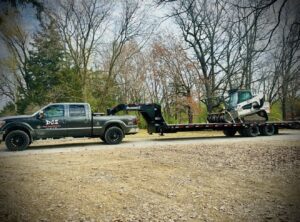
This is where the freeze-thaw cycle works in your favor. Once the ground freezes solid — typically by late November or December in the Prior Lake area — that same clay soil becomes a firm, stable work surface. Our tracked carrier and drum mulcher can move across frozen ground with far less impact than they’d have on a wet spring site.
If your property has drainage issues, wet low spots, or dense clay subsoil, scheduling fall or winter land clearing may give you a better outcome than waiting for the spring rush.
What Falls Under Fall vs. Winter Clearing
These two seasons aren’t identical when it comes to clearing work, and it helps to understand the differences before scheduling.
Fall Clearing (September Through November)
Fall is one of the best times for land clearing services in Minnesota for several reasons:
Vegetation is going dormant. By late September, buckthorn (Rhamnus cathartica), Eurasian honeysuckle (Lonicera tatarica), and prickly ash have started slowing their growth. This matters when you want to time herbicide treatment after mechanical clearing — treating cut stumps in fall, when sap is moving downward into the roots, gives the treatment the best chance of preventing regrowth.
Ground is firm but not yet frozen. You typically get a window from September through late October when the soil has dried out from summer but hasn’t yet frozen. Equipment can access most sites without the rutting risk you’d see in April.
Leaves are off the trees. Once foliage drops, operators can clearly see the canopy structure — helpful when selectively clearing around specimen trees, utility lines, or property boundaries.
Scheduling pressure is lower. Spring fills up fast, especially after a wet year when everyone wants the same narrow window. Booking fall clearing often means faster scheduling and more flexibility on project start dates.
Winter Clearing (December Through February)
Once the ground is fully frozen, winter becomes genuinely practical for the right kind of property. Our drum mulcher runs on a tracked carrier that can access slopes, soft areas, and wooded terrain that would be off-limits in a wet spring. With frozen ground under the machine:
- Saturated low spots and seasonal drainage areas become accessible
- Mulch chips settle more uniformly on frozen ground and begin breaking down when temperatures rise in spring
- Lakeshore properties and areas near wetlands that would be too soft in spring can often be safely reached
Winter timing also works well for fence line clearing and right-of-way clearing, where the goal is straightforward vegetation removal without fine-tuned selective work.
Buckthorn and Invasive Species: Fall Is the Right Time to Fight Back
One of the most compelling reasons to schedule fall land clearing services in Minnesota is invasive species management. Buckthorn (Rhamnus cathartica) and Eurasian honeysuckle (Lonicera tatarica) are two of the worst offenders across Scott County, Carver County, and the broader Twin Cities south metro.
Both species retain their leaves longer than native plants in fall — often staying green into November while native understory plants have already gone dormant. That makes fall the easiest time to spot them in the field. Walk through a woodland in mid-October and the bright green patches are almost always buckthorn or honeysuckle.
Mechanical removal with a drum mulcher cuts, chips, and incorporates material right into the soil surface. But follow-up stump treatment with herbicide is critical to prevent regrowth — and fall is the best window for that treatment. The Minnesota DNR recommends cut-stump herbicide treatment for common buckthorn from late summer through the fall, as the plant’s vascular system moves sugars downward into the roots and pulls the herbicide along with it.
Clearing buckthorn in fall and treating stumps before winter gives the treatment the best chance to work before the plant can respond in spring.
How This Affects Project Planning
Whether you’re clearing an overgrown fence line, reclaiming a hobby farm, preparing land for new construction, or improving a hunting property, the best time to start thinking about clearing is before your preferred window opens — not during it.
Here’s how most projects play out on a fall or winter timeline:
- August–September: Site assessment, consultation, project scoping
- October–November: Fall clearing work, especially for invasive species sites and well-drained properties
- December–February: Frozen-ground access for wet sites, clay-heavy areas, and lakeshore properties where spring access is limited
- Spring: Mulch has begun decomposing over winter; seeding or planting can begin; follow-up spot treatment on any invasive regrowth
Timeline depends significantly on your specific property — vegetation density, terrain, site access, and what you want to do with the land afterward all factor in. We’ll give you an honest assessment of what’s realistic for your site before any equipment moves.
“We had Jake out to clean the brush around our pond. He was very thorough and considerate to not get the debris into the pond. I would highly recommended DCS brush control to help clean up your property.” — Brian Pederson
FAQ: Fall and Winter Land Clearing in Minnesota
Q: Is it worth clearing in the fall if the ground isn’t frozen yet?
In most cases, yes. Fall provides good equipment access before the ground saturates from snowmelt, and it’s the best time for invasive species control — especially buckthorn stump treatment. If your site has decent drainage, fall is often the ideal window for land clearing services.
Q: How cold does it need to be before frozen-ground clearing makes sense?
You generally want the ground frozen to at least 4–6 inches deep. In the Prior Lake and Scott County area, this typically happens by December. We assess ground conditions before mobilizing equipment on sensitive or near-water sites.
Q: Can forestry mulching equipment work in snow?
Yes. Our tracked carrier handles snow-covered terrain well, and the drum mulcher processes vegetation effectively even when plants are dormant. Extreme cold (below -10°F) may affect equipment operation, but most Minnesota winter days are workable.
Q: Does land clearing cost more in winter?
Not necessarily. Winter scheduling often comes with better availability and can actually be more cost-effective than booking during the spring rush. Land clearing cost per acre in Minnesota depends more on vegetation density, terrain, and site conditions than on the season.
About the Author
Jake is the owner and lead operator at DCS Brush Control in Prior Lake, MN. He has spent over four years clearing land across Scott County, Carver County, and the Twin Cities south metro — from half-acre residential lots to 50-acre rural properties. When he’s not on a job site, he’s walking properties and giving free estimates to landowners who aren’t sure where to start.
Ready to Plan Your Fall or Winter Clearing Project?
If you’ve been putting off tackling that overgrown fence line, brushy back forty, or invasive-choked woodland, fall is the time to get on the schedule — not spring, when every other landowner in Scott County is making the same call.
DCS Brush Control provides land clearing services across Prior Lake, Scott County, Carver County, Dakota County, and the Twin Cities south metro. Call Jake at 612-554-0795 or reach out online to schedule a free property assessment. We’ll tell you honestly what your site needs, when to do it, and what to expect.